
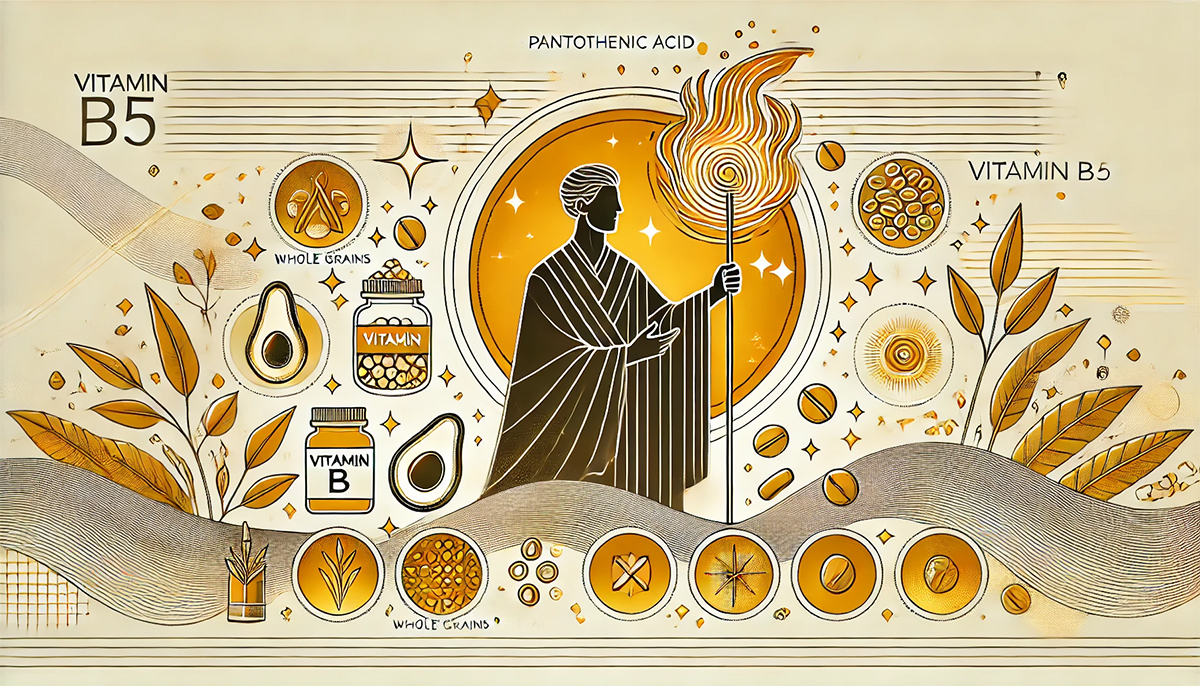
Introduction: Pantothenic Acid, the Energy Alchemist
Meet Vitamin B5, aka pantothenic acid—the everywhere-yet-nowhere star of the B-vitamin lineup, turning food into fuel and keeping your stress in check. From ancient grains to modern labs, this water-soluble workhorse (named for the Greek “pantos,” meaning “everywhere”) powers your cells with quiet gusto. Ready for a tale of stamina, skin, and science? Let’s unlock the magic of B5!
1. The Chemistry of Vitamin B5: The Coenzyme King
Vitamin B5, or pantothenic acid (C₉H₁₇NO₅), is a water-soluble B-vitamin that’s all about teamwork. It transforms into coenzyme A (CoA)—the MVP of metabolism—hustling carbon atoms to break down fats, carbs, and proteins for energy. That “A” in CoA? It’s B5’s handiwork, also crafting acetylcholine, a brain signal superstar. Fun fact: it’s so stable, cooking barely scratches it—your stew’s still loaded with B5 goodness.
2. The Humble History of Vitamin B5
In the 1930s, biochemist Roger J. Williams sniffed out a mystery nutrient keeping yeast alive. By 1933, he dubbed it pantothenic acid, proving it was everywhere—grains, meats, even microbes. Fast-forward to 1947: scientists linked it to CoA, cracking its energy code. Early clues? Chickens on B5-free diets grew weak and gray—farmers caught on quick. Bonus: wartime docs eyed it for adrenal support—stress was the enemy, and B5 was the shield.
3. Vitamin B5 Treasure Trove: Everyday Foods
B5’s hiding in plain sight—omnipresent and delicious:
-
- Meats: Chicken, beef (2–3 mg per 3 oz), liver (7 mg per serving)—carnivore’s delight.
- Whole Grains: Oats, brown rice (1–2 mg per cup)—hearty staples.
- Veggies: Broccoli, avocado (1 mg each), sweet potatoes—green and gold.
- Legumes: Lentils, peas (1–2 mg per cup)—plant-powered boosts.
- Dairy & Eggs: Yogurt, eggs (0.5–1 mg per serving)—creamy classics.
- Daily goal? 5 mg for adults—piece of cake (or chicken) to hit.
4. Exotic Vitamin B5 Superstars
Rare gems pack a B5 punch:
-
- Shiitake Mushrooms: 3.5 mg per 100g—Japan’s umami ace.
- Bee Pollen: 2–3 mg per ounce—nature’s hippie fuel.
- Sunflower Seeds: 7 mg per 100g—a snack with swagger.
These oddballs fueled ancient diets—think Roman legionnaires munching grains unknowingly loaded with B5.
5. Health Benefits: B5’s Superpowers
Pantothenic acid’s got low-key brilliance:
-
- Energy Engine: CoA turns food into ATP—your cells’ gasoline; no B5, no go.
- Stress Slayer: Fuels adrenal glands, pumping cortisol to tackle life’s chaos.
- Skin Soother: Speeds wound healing; creams with B5 (as panthenol) cut recovery time by 30%.
- Hair Hype: Strengthens follicles—shampoos love it, though proof’s thin.
- Cholesterol Cop: May trim LDL (bad cholesterol)—studies show 5–10% drops with high doses.
- Brain Buddy: Acetylcholine keeps memory sharp—low B5 fogs the mind.
- Wild stat: your body holds 1,000 times the daily dose—B5’s a hoarder!
6. The Dark Side: B5’s Rare Rebels
B5’s a saint—trouble’s scarce:
-
- Gut Grumbles: Mega-doses (10,000 mg+) spark diarrhea or bloating—overkill city.
- Allergy Oddity: Rare rashes pop up in sensitive souls—think 1-in-a-million.
- Balance Bust: Too much B5 might throw other B’s off—teamwork matters.
Deficiency? Near-mythical—only starved lab rats or tube-fed patients show it (weakness, tingling feet). Stick to 5–10 mg; more’s just flexing.
7. B5 in Action: Forms Galore
Get your B5 fix any style:
-
- Food First: Meats, grains, veggies—nature’s buffet.
- Supplements: Pantothenic acid pills (100–500 mg)—stress junkies swear by ‘em.
- Skin Savvy: Panthenol in lotions (5%)—hydrates and heals like a champ.
- Fortified Finds: Energy drinks, cereals—sneaky sprinkles.
Hack: Pair with protein—B5 loves a meaty assist.
8. Conclusion: The Everywhere Energizer
Vitamin B5 doesn’t scream for attention—it just works, churning energy, calming nerves, and patching you up. From yeast vats to war rations, its quiet reign powers on. Roast some chicken, mash an avocado, or dab on some cream—B5’s got you covered, no spotlight needed. In the B-vitamin band, this one’s the steady bassist—unfussy, unbreakable, essential.
Bonus Nuggets:
-
- Pet Power: Dogs need B5 too—deficiency dulls their coats and zest.
- Lab Lore: B5 reversed gray hair in mice—humans, not so much (sorry, silver foxes).
- Ancient Win: Greeks thrived on B5-rich barley—warriors didn’t know their secret.
List of all Vitamins:
| Vitamin | Where | % Daily Intake (DI) |
|---|---|---|
| Vitamin A | Liver, carrots, sweet potatoes | 900 mcg (men), 700 mcg (women) |
| Vitamin B1 (Thiamine) | Pork, whole grains, sunflower seeds | 1.2 mg (men), 1.1 mg (women) |
| Vitamin B2 (Riboflavin) | Dairy, liver, spinach | 1.3 mg (men), 1.1 mg (women) |
| Vitamin B3 (Niacin) | Chicken, tuna, peanuts | 16 mg (men), 14 mg (women) |
| Vitamin B5 (Pantothenic Acid) | Eggs, avocado, mushrooms | 5 mg (unisex AI) |
| Vitamin B6 (Pyridoxine) | Salmon, bananas, chickpeas | 1.7 mg (men), 1.5 mg (women) |
| Vitamin B7 (Biotin) | Nuts, eggs, sweet potatoes | 30 mcg (unisex AI) |
| Vitamin B9 (Folate/Folic Acid) | Leafy greens, lentils, fortified grains | 400 mcg (unisex) |
| Vitamin B12 (Cobalamin) | Beef, clams, fortified milks | 2.4 mcg (unisex) |
| Vitamin C (Ascorbic Acid) | Oranges, peppers, strawberries | 90 mg (men), 75 mg (women) |
| Vitamin D | Sun, salmon, fortified dairy | 15 mcg (600 IU, unisex) |
| Vitamin E | Almonds, spinach, wheat germ | 15 mg (unisex) |
| Vitamin K | Kale, natto, liver | 120 mcg (men), 90 mcg (women) |